High-Intensity Daily Personal Activities

NDIS-registered support for participants with complex health needs. All high-intensity care is delivered by trained support workers under AHPRA Registered Nurse oversight.

What high-intensity daily personal activities are

High-intensity daily personal activities (HIDPA) are personal care supports for participants with complex health needs.

They are not standard personal care. They require support workers with specific training and clinical knowledge, and providers registered and audited under NDIS Practice Standards Module 1.

HIDPA is for participants who need ongoing assistance with tasks that carry a higher level of clinical risk. This includes participants managing medical conditions such as:

  • Complex bowel care needs
  • Enteral (tube) feeding
  • Severe dysphagia (swallowing difficulties)
  • Ventilator or tracheostomy support
  • Urinary catheter management
  • Subcutaneous injections
  • Complex wound care
  • Epilepsy and seizure support
  • If your NDIS plan includes funding for high-intensity supports, you can use that funding with SA Holistic Care.

    How we support you

    We provide tailored, high-intensity clinical support across the following areas:

    Complex bowel care

    Support tailored to your individual care plan, managed safely and with dignity.

    Enteral feeding and management

    PEG and tube feeding delivered in line with your nutrition and medication plan.

    Severe dysphagia management

    Support with swallowing difficulties, in line with your speech pathologist's recommendations.

    Ventilator and tracheostomy care

    Respiratory support for participants who require it as part of daily living.

    Catheter and continence

    Urinary catheter management and continence support, delivered with discretion and respect.

    Subcutaneous injections

    Administered as prescribed and documented at every visit.

    Complex wound care

    Wound management and tissue viability support.

    Epilepsy and seizure support

    Trained response and monitoring as outlined in your support plan.

    Clinical oversight

    All high-intensity support at SA Holistic Care is overseen by an AHPRA Registered Nurse.

    Every support worker is trained specifically to your individual care needs, not a generic certificate applied across participants. Training is delivered by a qualified health practitioner and reviewed as your needs change.

    Is this support right for you?

    High-intensity daily personal activities may be right for you if:

  • You have an NDIS plan with funding for high-intensity supports
  • You have a complex health condition that requires clinical knowledge to support safely
  • You need regular assistance with one or more of the activities listed above
  • You are currently receiving these supports and want to change providers
  • If you are not sure whether your plan includes HIDPA funding, your support coordinator or Local Area Coordinator (LAC) can confirm this.

    How to get started

    Our process is designed to make it easy for you to start with us

    1

    Contact us or book a free consultation

    Call us, submit an enquiry , or book a free consultation, we will talk through your situation and tell you directly what we can do.


    2

    We assess your needs

    We conduct a thorough intake assessment covering your support needs, health status, clinical risks, and NDIS plan. This is the foundation your support is built on.


    3

    We build your support plan

    Your plan is written for you specifically, what support you need, how it is delivered safely, and what your worker must know. Where clinical complexity is involved, your treating team is consulted.


    4

    We match you with a trained worker

    We assign a worker with current NDIS High-Intensity Support module certification for your specific needs. They are briefed on your plan before their first visit.


    5

    Clinical oversight throughout

    All high-intensity support is overseen by an AHPRA Registered Nurse. There is clinical governance behind every visit.

    FAQ's

    Common questions

    Most frequently asked questions about our High-Intensity Daily Personal Activities service

    What does Module 1 certification actually mean?

    Module 1 is the NDIS training framework for workers delivering complex personal care. It covers specific clinical skills including enteral feeding, complex bowel care, tracheostomy management, ventilator support, subcutaneous injections, and catheter care. Certification must be specific to each participant's needs. A worker certified for PEG feeding is not automatically certified for tracheostomy care. We ensure workers hold the exact competencies your care requires.

    What is the role of the Registered Nurse in high-intensity support?

    Our AHPRA Registered Nurse designs and signs off every care routine before it begins, conducts regular audits, and is available on-call for clinical escalation. The RN is clinically responsible for every routine, not just the visits they attend directly.

    Can high-intensity support be delivered alongside community nursing?

    Yes, and for many participants, both are needed. Community nursing is clinical care delivered by a Registered Nurse directly. High-intensity support is clinical personal care delivered by a trained support worker under RN oversight. We coordinate both under the same clinical governance framework.

    What happens if my condition changes or deteriorates?

    Your care plan is reviewed immediately following any significant change. For urgent concerns, your support worker has direct on-call access to our senior Registered Nurse at any time. We do not wait for a scheduled review.

    How do you manage infection control?

    We follow strict infection control protocols across all high-intensity supports, including appropriate PPE, equipment hygiene, and documented procedures for each clinical task. For participants at elevated infection risk, additional precautions are built into the care plan from the start.

    What if a support worker is unavailable for a high-intensity shift?

    We do not send an uncertified worker to cover a shift. If certified cover is not available, we notify you immediately and work with you to manage the gap safely, including escalating to nursing care where needed.

    Can high-intensity support be provided in a SIL or STA setting?

    Yes. High-intensity daily personal activities can be integrated into a Supported Independent Living arrangement or delivered during a Short-Term Accommodation stay. Staffing, clinical oversight, and care plans are all confirmed before support begins.

    Does my NDIS plan need to specifically include HIDPA funding?

    Yes. High-intensity supports must be included in your NDIS plan with funding allocated at the high-intensity rate. If you are not sure whether your plan covers this, your support coordinator or LAC can confirm.

    Can I use SA Holistic Care if I self-manage my NDIS funding?

    Yes. If you self-manage, you are responsible for ensuring your provider meets the required standards. SA Holistic Care is registered and audited under Module 1.

    What happens if my health needs change?

    Your support plan is updated before your next visit. Your AHPRA Registered Nurse reviews your plan whenever there is a significant change in your condition.

    Can I switch to SA Holistic Care from another provider?

    Yes. Contact us and we will guide you through the process. We conduct a new intake assessment and build your support plan before any care begins.

    How quickly can support start?

    This depends on your individual assessment. We will give you a clear timeframe after your initial consultation.

    Ready to book or just want to ask some questions?

    Call our team on 0430 505 394, or submit an enquiry and we'll respond within 4 business hours.

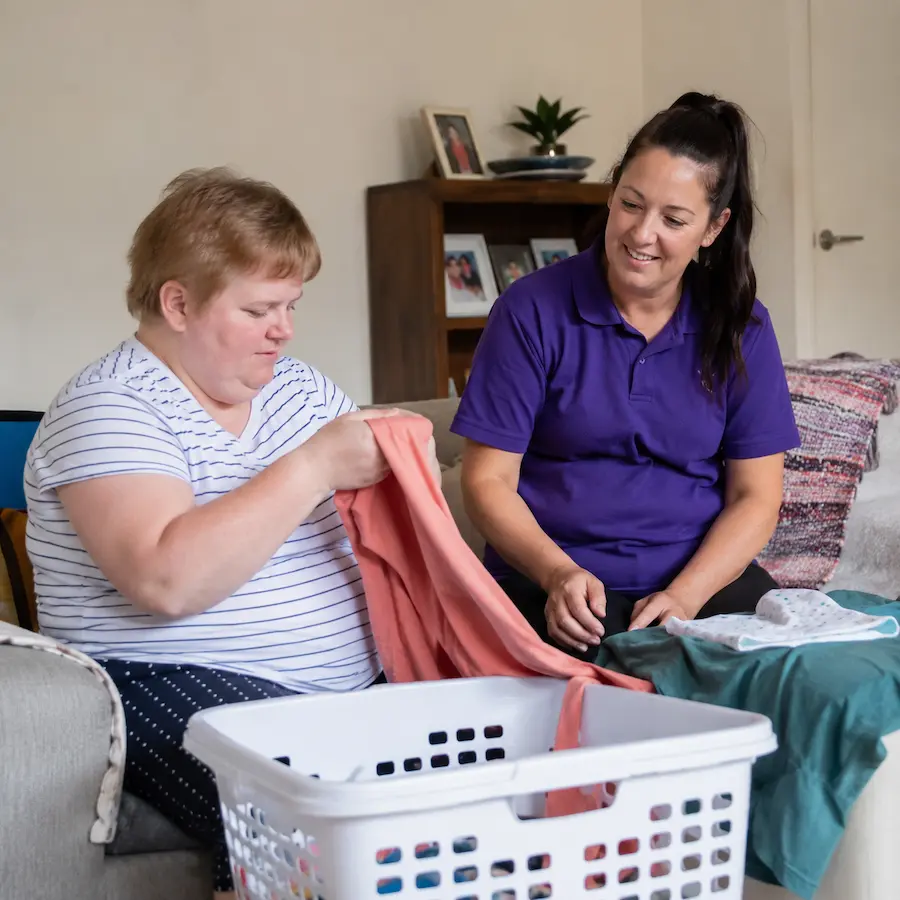
    SIL participant folding her clothes and support worker is guidig her